Mid-Year Bookkeeping Cleanup Checklist for Small Business Owners

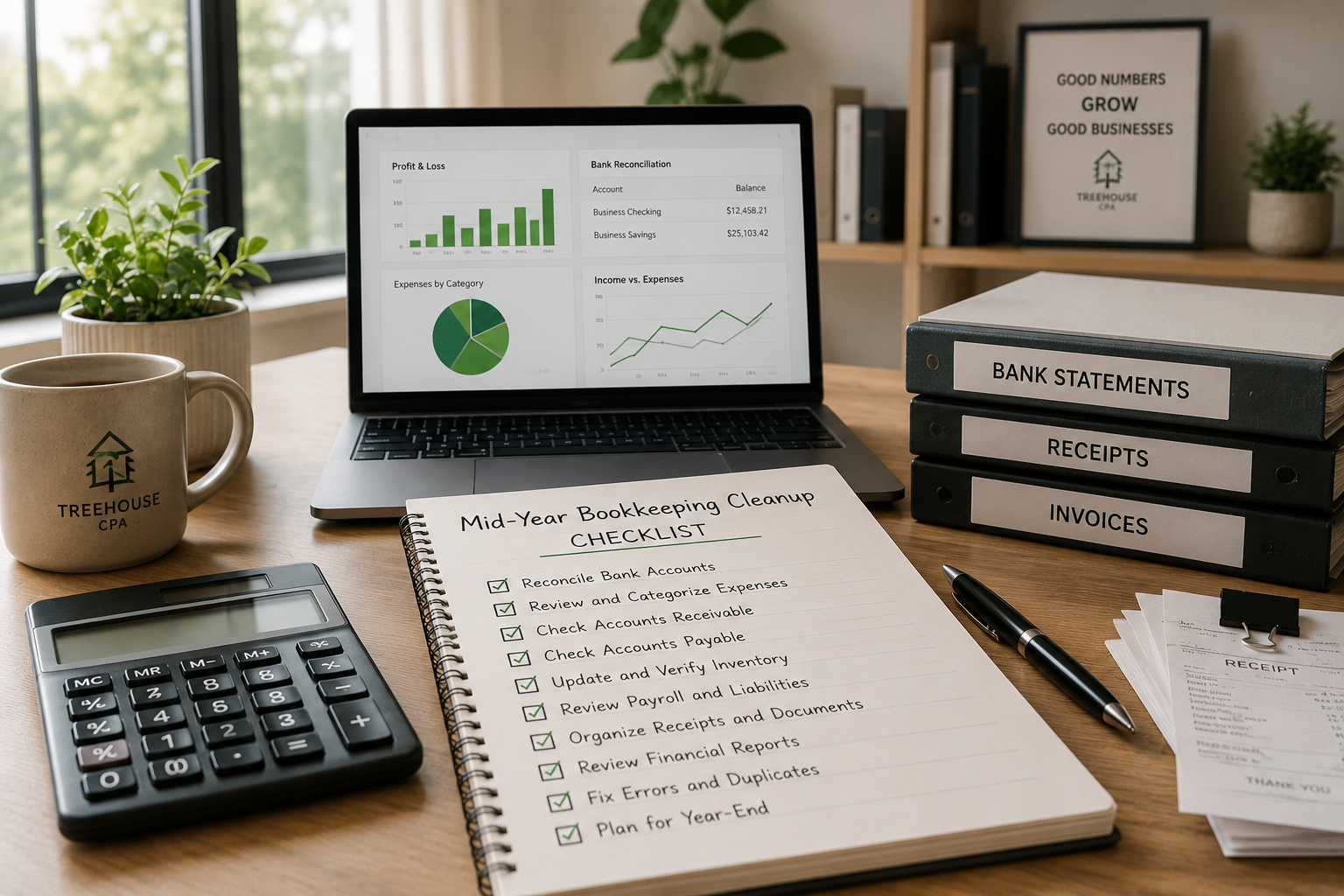
Messy books? Ottawa CPA Majdi Ibrahim's mid-year bookkeeping checklist covers GST/HST, shareholder loans, payroll, and tax planning.
By Majdi Ibrahim, CPA | Majdi Ibrahim, CPA Professional Corporation | Ottawa, Ontario
Most small business owners think about bookkeeping twice a year: when they need to file something, and when their accountant asks for records. By then, six or twelve months of transactions have piled up — uncategorized, misclassified, or missing receipts entirely. A mid-year bookkeeping cleanup checklist helps small business owners catch these issues while there is still time to fix them.
Mid-year is a better time. Not because of a deadline, but because you still have time to fix things. A July cleanup gives you a clear picture of where your business stands financially, surfaces tax issues before they become expensive surprises, and gives you and your CPA something to actually work with when planning the second half of the year.
This checklist is for Ottawa small business owners, self-employed individuals, incorporated consultants, landlords, and anyone who suspects their books aren't quite where they should be.
Why Mid-Year Bookkeeping Matters
Clean books aren't just a compliance exercise. They're a planning tool.
When your books are current and accurate, you can see your year-to-date profit, understand your cash flow, make informed decisions about salary or dividends, plan for tax instalments, and identify deductions you might otherwise miss. When they're messy, all of that becomes guesswork — and guesswork at year-end is expensive.
A mid-year review also catches problems while they're still fixable. A GST/HST miscoding that's been running for six months can be corrected now. A shareholder loan that's been accumulating since January can be addressed before the year-end deadline. Missing receipts from earlier in the year are easier to reconstruct in July than in February.
The businesses that handle year-end smoothly — with minimal surprises and a clear tax plan — are almost always the ones that stayed reasonably current throughout the year.
The Mid-Year Cleanup Checklist
✅ 1. Reconcile Your Bank and Credit Card Accounts
Every transaction in your accounting software should match your actual bank and credit card statements. If it doesn't, you have one of three problems: a missing transaction, a duplicate, or a recording error — each of which distorts your financial picture.
For most small businesses using QuickBooks, Xero, or even a spreadsheet, mid-year reconciliation means:
- Matching every bank transaction to a recorded entry
- Confirming every credit card charge is captured
- Identifying any unexplained differences and resolving them
If you haven't reconciled since January, start there. Nothing else on this list is reliable until the bank matches the books.
✅ 2. Clear Uncategorized and Miscategorized Expenses
Most accounting software has an "uncategorized" or "ask my accountant" bucket where transactions land when nobody's sure what to do with them. Mid-year, that bucket is usually full.
Go through it. Most of those transactions belong somewhere specific — professional fees, office supplies, software subscriptions, meals, vehicle costs. Categorizing them correctly affects both your income statement and your deductible expenses at year-end.
Miscategorized transactions are equally important. A capital purchase that was expensed immediately, a personal item sitting in a business account, or a loan repayment coded as an expense — these create errors that compound over time and can cause problems on audit.
✅ 3. Track Down Missing Receipts and Source Documents
CRA requires source documents to support deduction claims. "My bank statement shows a charge at Canadian Tire" is not a receipt. Receipts establish what was purchased and that it was for a business purpose.
The longer you wait, the harder receipts are to recover. A July cleanup is realistic — you're only a few months back. A February cleanup means trying to reconstruct purchases from a year ago.
For missing receipts, check:
- Email for digital receipts (most suppliers email them)
- Credit card statements with merchant descriptions
- The supplier's account portal (many keep invoice history)
- Your CRA My Business Account if the expense involved a CRA-related payment
As a practical rule, keep receipts, invoices, bank statements, and supporting documents organized by year and category so they can support the return if CRA asks later.
✅ 4. Review GST/HST Coding and Input Tax Credits
For GST/HST registrants, every expense in the books needs the right tax coding — was HST collected or paid, and is it claimable as an Input Tax Credit (ITC)?
Common GST/HST bookkeeping errors include:
- Claiming ITCs on exempt supplies or personal expenses
- Missing ITCs on legitimate business expenses
- Incorrectly coding out-of-province or zero-rated transactions
- Not tracking HST collected separately from revenue
Mid-year is also a good time to confirm your filing frequency is still correct. Most businesses with annual taxable revenues under $1.5 million file annually, those over $1.5 million but under $6 million file quarterly, and those over $6 million file monthly. If your revenue has grown significantly, your GST/HST reporting frequency should be reviewed — CRA generally assigns reporting periods based on taxable revenue thresholds, and growing businesses may eventually move from annual to quarterly or monthly filing.
If you're an annual filer and your prior-year net GST/HST owing was $3,000 or more, you're likely required to make quarterly instalment payments throughout the year. Catching a missed instalment mid-year is far better than discovering it when the annual return is due.
✅ 5. Review Payroll, Source Deductions, and T4/T5 Planning
For incorporated business owners and employers, payroll deserves a mid-year check:
- Are source deductions being calculated correctly?
- Are remittances being made on time and in full?
- Has the compensation mix (salary vs. dividends) been reviewed for the year so far?
If you've been taking draws from the corporation without formally declaring salary or dividends, now is the time to have that conversation before year-end. Salary generally creates payroll remittance and T4 reporting obligations, while dividends generally require proper corporate authorization and T5 reporting. The decisions you make about salary and dividends affect RRSP room, CPP contributions, your personal tax rate, and your corporate deduction. Mid-year is when there's still time to adjust.
We cover the salary vs. dividends decision in detail in our salary vs. dividends guide, and the broader question of paying yourself from a corporation in our how to pay yourself article.
✅ 6. Review the Shareholder Loan Account
If you're incorporated, the shareholder loan account is one of the most important balances to review at mid-year — and one of the most commonly ignored until year-end, when it's sometimes too late to fix cleanly.
A debit shareholder loan balance generally needs to be resolved within one year after the end of the corporation's taxation year in which the loan was made, unless a specific exception applies. If the balance has been building throughout the year — from unrecorded draws, personal expenses run through the company, or informal transfers — mid-year is the right moment to understand what's there and make a plan.
We cover the shareholder loan rules in full in our shareholder loans article.
✅ 7. Split Loan Payments Between Principal and Interest
This one is frequently wrong. Loan payments — whether for a business vehicle, equipment, or a line of credit — consist of a principal portion and an interest portion. Only the interest is deductible. The principal is not.
If your bookkeeping is recording the entire loan payment as an expense, you're overstating deductions. If it's recording the entire payment as a balance sheet reduction, you're missing the deductible interest. Either way, it needs to be split correctly — and the split changes every payment as the loan amortizes.
Your lender's annual statement usually shows the interest vs. principal breakdown. If your bookkeeping software isn't handling this correctly, mid-year is when to fix it, not April.
✅ 8. Clean Up Rental Property Records (If Applicable)
For landlords with rental income, mid-year cleanup includes:
- Confirming rent received is recorded accurately by property and period
- Reviewing expense categorization (repairs vs. capital improvements is a common error)
- Checking that shared-expense proration (for partially personal-use properties) is being applied consistently
- Confirming that CCA decisions have been made deliberately, not by default
Rental income is reported on Form T776, and clean records by property make that much easier.
✅ 9. Separate Personal and Business Expenses
This is one of the most common bookkeeping problems in small businesses — and the most straightforward to address.
Personal expenses run through the business account — a grocery run, a personal Amazon order, a family dinner — create problems in two directions. If they're deducted as business expenses, they're inaccurate. If they're left unresolved in the books, they inflate the shareholder loan balance or create unexplained variances.
The fix is simple in principle: flag personal items, remove them from business deductions, and either reimburse the business or record them as a draw. The hard part is actually going through the transactions and making that call for every one. Mid-year with six months of history is manageable. Mid-year after ignoring it for three years is a bigger project.
✅ 10. Review Year-to-Date Profit and Tax Position
Once the books are clean, look at the number. What does year-to-date profit actually look like?
This matters for several practical reasons:
- Tax instalments. If you're self-employed or have significant non-employment income, CRA may expect quarterly personal tax instalments (March, June, September, December). A mid-year profit review tells you whether your instalment amounts are on track.
- Corporate tax instalments. Corporations generally have to pay income tax instalments monthly or quarterly if their tax payable is more than $3,000, subject to specific exceptions. If corporate income is tracking higher than last year, the instalment amounts may need to increase accordingly.
- Compensation decisions. For incorporated owners, knowing where the corporation stands mid-year is exactly the input needed to make intelligent salary, bonus, and dividend decisions before year-end. We cover this in our year-end checklist.
When to Get a CPA Involved
Not every business needs a CPA to do their own bookkeeping. But there are situations where a mid-year conversation with a CPA is genuinely worth it:
- Your books haven't been touched since your last tax filing
- You're incorporated and haven't discussed salary vs. dividends with anyone
- You're not sure if your shareholder loan balance is an issue
- Your GST/HST returns feel uncertain or have been filed inconsistently
- Your business income is significantly higher (or lower) than last year and you're not sure what that means for your taxes
- You have rental income alongside business income and the two are getting confused
Bookkeeping cleanup is not just about keeping CRA happy. It's about giving you the information you need to make good decisions. That's what it's actually for.
What Happens When You Bring This to Majdi Ibrahim, CPA?
We start with where you actually are. Not where you think you are. We look at the books, identify the gaps, and give you a clear picture of what needs to be cleaned up and why.
We fix what matters most, in order. Reconciliations first, then miscategorizations, then the shareholder loan and payroll questions. We prioritize based on what's going to affect your tax position and planning.
We connect the cleanup to a plan. Clean books are the starting point for planning — not the end. Once we know where you stand, we can assess your instalment position, model salary vs. dividend options, and flag anything that needs attention before year-end.
We make year-end much less painful. Businesses with tidy mid-year books close their year in days, not weeks. The accountant bill is lower, the surprises are fewer, and the planning conversations are more productive.
Book a consultation at www.treehousecpa.com
Frequently Asked Questions
Can I clean up my bookkeeping myself, or do I need a CPA?
You can clean up basic items yourself, such as matching bank transactions, uploading receipts, and identifying personal expenses. A CPA becomes more useful when the cleanup affects GST/HST, payroll, shareholder loans, tax instalments, salary/dividend planning, or prior-year corrections.
How often should I be doing bookkeeping for my small business?
Monthly is ideal for most small businesses — it keeps reconciliations manageable, ensures GST/HST coding is current, and means you always have an accurate picture of where you stand. Quarterly is workable for simpler operations. Waiting until year-end is when problems accumulate and cleanup becomes expensive.
What's the difference between a bookkeeper and a CPA for this kind of work?
A bookkeeper handles the day-to-day recording, categorization, and reconciliation of transactions. A CPA interprets what those numbers mean for your tax position, advises on salary/dividends, reviews the shareholder loan, and connects the bookkeeping to planning. For mid-year cleanup, you often need both — or a CPA-led firm that handles both levels.
My GST/HST returns have been inconsistent. Is it too late to fix them?
It depends on the nature and degree of the errors. In many cases, adjustments can be made to future returns or prior periods can be corrected. In some situations, a voluntary approach to CRA makes more sense than waiting. This is worth discussing with a CPA before doing anything.
I'm incorporated and have been taking draws without formalizing them. What should I do?
This is the shareholder loan issue. The draws are sitting as a debit balance on the corporation's books, and they need to be resolved before the one-year deadline. The resolution could be declaring salary, declaring dividends, or repaying the corporation. Mid-year gives you time to do this properly. See our shareholder loans article for a fuller explanation.
I use QuickBooks but I'm not sure I'm using it correctly. Is that worth fixing?
Yes. The most common QuickBooks issues — transactions sitting in "uncategorized," HST not coded properly, loan payments not split, personal and business expenses mixed — are all fixable, and they all affect your tax return. A mid-year review of how your software is set up is usually a few hours of work that pays for itself at year-end.
This article is provided for general informational purposes only and does not constitute personalized tax, legal, or financial advice. Tax rules are subject to change. Please consult a CPA for advice specific to your situation.