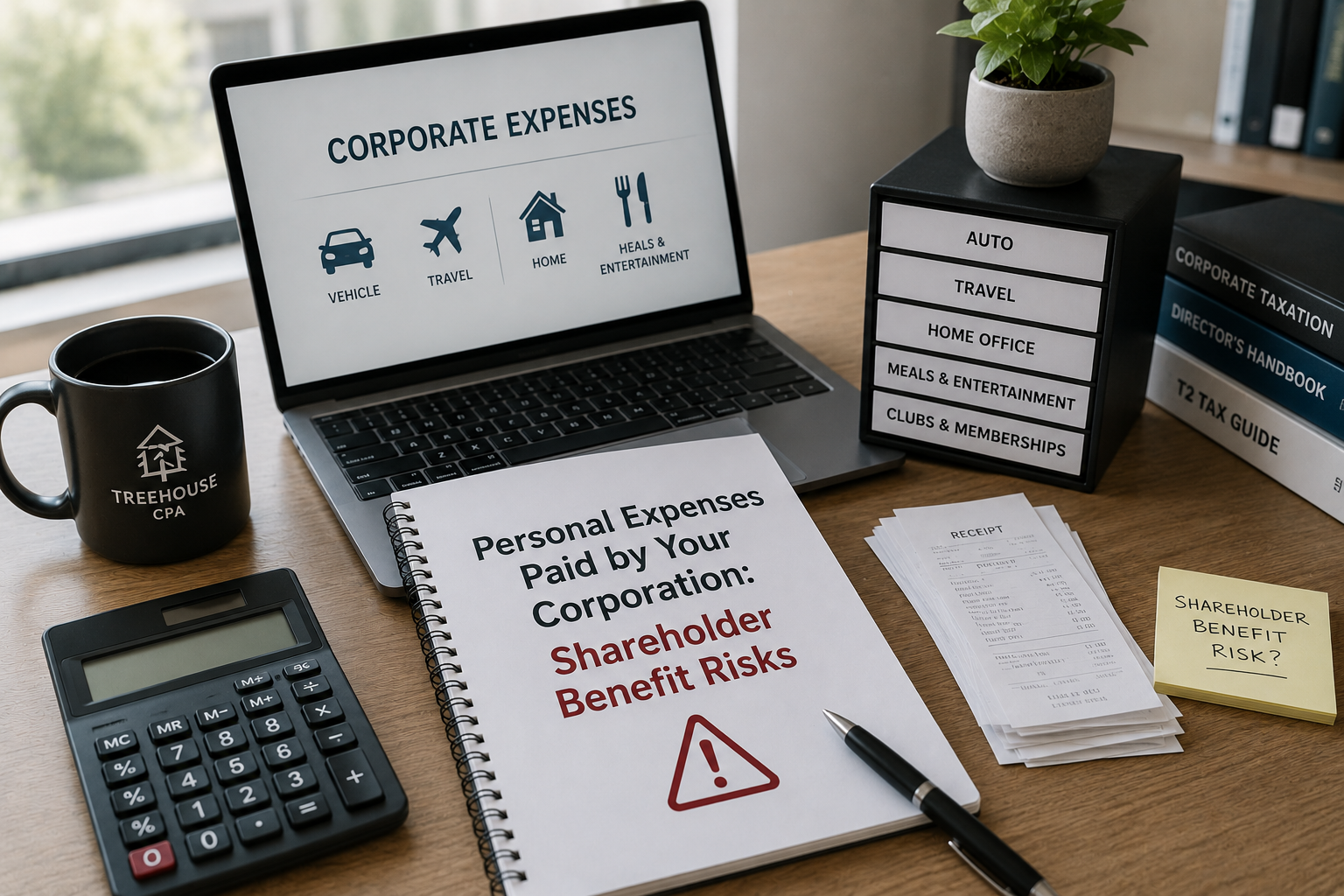
Personal Expenses Paid by Your Corporation: Shareholder Benefit Risks

Used the corporate card for personal expenses? Ottawa CPA Majdi Ibrahim explains what happens, how it's classified, and how to clean it up.
By Majdi Ibrahim, CPA | Majdi Ibrahim, CPA Professional Corporation | Ottawa, Ontario
It happens all the time. You're at the grocery store and grab the corporate card instead of your personal one. You book a family trip and put it on the business account because the cash flow is better. You renovate the basement and expense part of it as a home office improvement. Your Amazon account is connected to the corporate card, and the line between personal and business purchases has gotten a little blurry.
For many incorporated business owners, this feels natural. The corporation generates the income. You own the corporation. The money feels like yours.
But the corporation is a separate taxpayer — a distinct legal entity from you personally. When the corporation pays for something personal on your behalf and it isn't properly classified, reimbursed, or reported, it can create a tax problem: the corporation may not get the deduction it expected, and you may end up with a personal income inclusion anyway. This can create a double-tax problem: the corporation may not get a deduction, while the shareholder still has a personal income inclusion — a worse outcome than simply paying yourself salary or dividends in the first place.
This article explains what happens when personal expenses flow through a corporation, what the tax consequences are, and how these situations typically get cleaned up. We cover shareholder loans in our shareholder loans article and compensation planning in our salary vs. dividends guide. This article focuses on personal expenses paid by the corporation.
At a Glance
The corporation is a separate taxpayer. Personal expenses paid by the corporation are not automatically deductible business expenses — they need to be properly classified, reimbursed, reported, or cleaned up.
Business expenses must be incurred to earn business income. A grocery run, a family vacation, or personal clothing does not become a deductible business expense because the corporation paid for it.
Personal expenses in the books can trigger several problems — overstated deductions, incorrect GST/HST claims, a growing shareholder loan balance, and potential shareholder benefit exposure.
Subsection 15(1) of the Income Tax Act applies where the corporation confers a benefit on the shareholder. This can create a double-tax problem: the corporation may not get the deduction, while the shareholder still has a personal income inclusion.
These issues are usually fixable — but they should be fixed deliberately, not ignored.
Common Personal Expenses That Cause Problems
Here are the personal expenses that most commonly end up in corporate books:
- Groceries and household supplies — run through the corporate card at Costco, Loblaws, or similar
- Family meals and personal dining — coded as "meals and entertainment" without a business purpose
- Personal Amazon, Walmart, or online purchases — mixed in with office supply orders
- Vacations and personal travel — booked through the same account as business trips
- Home renovations — partially or fully expensed as business or home office costs
- Personal vehicle costs — fuel, repairs, insurance on a vehicle used partly or entirely for personal driving
- Children's expenses — activities, school supplies, clothing
- Personal subscriptions — streaming services, fitness apps, personal software
- Clothing and personal appearance — unless meeting very specific work-related criteria
- Medical or dental costs — paid through the corporation without a proper employee benefit plan
- Unexplained owner transfers — cash or e-transfers to personal accounts with no clear category
- Mixed-use home office or vehicle expenses — claimed at 100% when only a portion is business
Not every personal-looking expense is automatically wrong. Some expenses have a legitimate business purpose. The issue is whether the expense was incurred to earn business income, properly documented, and correctly classified.
Why Personal Expenses Are Not Corporate Deductions
Business expenses are generally deductible to a corporation if they are incurred to earn business income. Personal expenses are not deductible simply because the corporation paid for them.
A few examples that come up often:
Groceries are not meals and entertainment. Meals and entertainment deductions relate to meals with clients, employees, or business associates for a genuine business purpose — not household groceries.
A family vacation is not a business trip. Checking email during a vacation does not convert a personal trip into a deductible business expense. The primary purpose of the trip matters.
Personal home renovations are not corporate repairs. A home office may support a partial deduction for a reasonable proportion of shared costs — but personal renovations, landscaping, or structural improvements to a home are not corporate expenses just because the owner works from home.
Personal clothing is generally not deductible. Unless clothing is a uniform, protective gear, or worn exclusively for work and not suitable for personal use, clothing is a personal expense.
When personal expenses are coded as business deductions, corporate taxable income is understated. If the corporation is audited, those deductions can be reversed — along with interest, and potentially penalties.
How Personal Expenses Show Up in the Books
Personal expenses don't always show up labelled as "personal." They're often coded as:
- Meals and entertainment
- Office supplies
- Travel
- Vehicle expenses
- Repairs and maintenance
- Uncategorized / "ask my accountant"
- Shareholder loan or owner draws
The classification matters because it affects:
- Corporate taxable income — miscategorized personal expenses overstate deductions
- Shareholder loan balance — unresolved draws accumulate as a debit against the shareholder
- Shareholder benefit exposure — depending on the facts, some amounts may be assessed as shareholder benefits under subsection 15(1)
- GST/HST input tax credits — ITCs claimed on personal expenses may need to be reversed
- Year-end salary/dividend planning — the compensation picture depends on accurate books
- Financial statement accuracy — lenders and other stakeholders rely on these numbers
This is why mid-year bookkeeping cleanup is so valuable — catching these issues while the year is still open leaves more options for correction. We cover that in our mid-year bookkeeping cleanup checklist.
Subsection 15(1): When a Personal Expense Becomes a Taxable Benefit
When a corporation pays for a personal expense on behalf of a shareholder — and the amount isn't properly reimbursed or restructured — it may be treated as a shareholder benefit under subsection 15(1) of the Income Tax Act.
Subsection 15(1) applies where a corporation confers an economic benefit on a shareholder or a related person without receiving fair market value in return. The amount or value of the benefit is included in the shareholder's income for the year it was received.
The double-tax problem: The corporation may not be able to deduct the expense (because it was personal, not a business expense), while the shareholder still has a personal income inclusion. This can produce a worse outcome than simply paying the same amount as salary or dividends through proper channels.
Shareholder benefits are generally reported on a T4A, while employment benefits are generally reported on a T4. No source deductions are withheld on a T4A — the shareholder pays the tax personally when filing.
If the benefit is actually received in the individual's capacity as an employee rather than as a shareholder, payroll reporting, source deductions, and CPP treatment may differ. The shareholder-versus-employee capacity should be reviewed.
Other Situations That Can Create Shareholder Benefits
While personal expenses are the most common trigger, a few other situations are worth noting briefly:
Below-FMV sales or transfers. If the corporation sells an asset to the shareholder below fair market value — a vehicle, equipment, or real estate — the difference between FMV and the price paid is a shareholder benefit.
Personal use of corporate property. If the shareholder uses corporate property (a vehicle, a vacation property) personally without paying FMV for that use, a benefit arises. For corporate vehicles where the shareholder is also an employee, CRA has specific standby charge and operating benefit rules.
Forgiven or written-off amounts. If the corporation forgives a shareholder loan or writes off a debt, the forgiven amount may be treated as a benefit under subsection 15(1), or in some cases as a deemed dividend. The specifics depend on how the forgiveness is structured and what other provisions apply.
Shareholder Benefit vs. Shareholder Loan: The Practical Difference
Whether a personal expense is a shareholder benefit or a shareholder loan depends on the facts — specifically, whether there was a genuine intention and plan to repay.
- Shareholder loan (subsection 15(2)): A shareholder loan under subsection 15(2) is an amount the shareholder owes to the corporation. It may avoid income inclusion if it is repaid within one year after the end of the corporation's taxation year in which the loan arose, provided the repayment is not part of a series of loans or repayments. In practice, salary or dividends may be used as part of a broader cleanup plan, but the treatment should be reviewed. We cover this fully in our shareholder loans article.
- Shareholder benefit (subsection 15(1)): Once a true shareholder benefit has been conferred, it is generally not resolved the same way as a shareholder loan. Prompt reimbursement and proper documentation may prevent a benefit from arising, but a journal entry alone is not enough.
CRA looks at the substance of the transaction, not just how it's recorded in the books. A journal entry crediting the shareholder loan account does not, by itself, establish that a loan was intended.
GST/HST Problems From Personal Expenses
Input Tax Credits (ITCs) are generally available on expenses used in commercial activity. Personal expenses coded as business expenses may generate incorrect ITC claims.
Common GST/HST issues from personal expenses:
- ITCs claimed on groceries, personal meals, or household items coded as business supplies
- ITCs claimed on personal vehicle use that should be prorated
- ITCs claimed on home renovations coded as business repairs
- Mixed-use expenses where only a portion supports commercial activity
Cleanup may require correcting GST/HST coding, repaying overclaimed ITCs, or adjusting prior returns. This is one more reason that accurate bookkeeping throughout the year matters — the GST/HST implications of personal-business mixing are separate from (and in addition to) the income tax consequences.
How These Items Usually Get Cleaned Up
There is no one-size-fits-all answer. The right cleanup depends on the facts, timing, corporate profit, shareholder loan balance, payroll history, cash flow, and documentation. Common approaches include:
- Reclassify as a shareholder loan or owner draw — record the amount as a draw the shareholder owes the corporation, then plan to resolve the loan balance within the one-year window
- Have the shareholder repay the corporation — prompt actual reimbursement, supported by payment evidence, may prevent a benefit from arising or reduce the benefit exposure
- Declare salary or a bonus — where the corporate income and payroll structure support it, salary can offset the shareholder loan balance while generating a corporate deduction
- Declare dividends — a properly documented dividend can offset the shareholder loan balance; taxable to the shareholder at dividend rates
- Report a shareholder benefit — where the expense was genuinely personal and was not reimbursed, and the circumstances support a benefit assessment, it should be properly reported on a T4A
- Correct GST/HST ITC coding — reverse ITCs that were incorrectly claimed on personal expenses
- Adjust prior filings — where prior-year returns were filed with incorrect deductions or missing benefit inclusions, adjustments or catch-up filings may be needed
How Majdi Ibrahim, CPA Helps You Navigate This
Sorting out personal expenses in a corporate account takes more than a spreadsheet. Here's what we do:
- Review corporate bank statements and credit card transactions to identify personal, mixed-use, and business expenses
- Separate true business expenses from owner draws, shareholder loans, or shareholder benefits
- Review the shareholder loan account and assess the repayment timeline
- Decide whether repayment, salary, dividends, benefit reporting, or reclassification is the right path — given the corporate income, shareholder loan balance, and personal tax picture
- Review GST/HST ITC coding and correct any overclaimed credits
- Clean up the books before year-end or before filing the T2
- Explain the tax impact in plain English before any decisions are made
- Set up a better process so the issue doesn't repeat year after year
This is common, and it is usually fixable — but it should be fixed deliberately, not ignored.
What Happens When You Bring This to Majdi Ibrahim, CPA?
Transaction review. We go through your corporate bank and credit card transactions and flag what belongs where — business expense, personal draw, shareholder loan, or benefit.
Shareholder loan cleanup. If personal expenses have been accumulating as an unresolved debit balance, we review the balance, the timeline, and the best path to clean it up before it creates a bigger problem.
GST/HST review. We check whether ITCs were claimed on personal expenses and correct the coding where needed.
Salary/dividend cleanup. We assess whether declaring salary or dividends is the right way to offset personal draws, given your personal income, RRSP room, CPP position, and the corporate tax picture. We cover this in our how to pay yourself article.
Shareholder benefit reporting where required. Where an amount should have been reported as a T4A benefit, we help you understand the exposure and address it properly.
Year-end planning. The right time to deal with personal expenses in the corporate account is before the year closes — when salary, dividend, and repayment options are still available. We cover year-end checkpoints in our year-end checklist.
Plain-English explanation. We don't just tell you what the rules say — we explain what it actually costs, what the options are, and which path makes the most sense for your situation.
A cleaner process going forward. Setting up a simple system — separate personal and corporate cards, a regular bookkeeping review, a clear policy for reimbursements — prevents this from recurring year after year.
Book a consultation at www.treehousecpa.com
Frequently Asked Questions
Can my corporation pay personal expenses?
Technically, the corporation can make payments for almost anything — but that doesn't mean those payments are deductible business expenses or that there are no tax consequences. Personal expenses paid by a corporation need to be properly classified. Depending on how they're handled, they may end up as a shareholder loan, a shareholder benefit, or a disallowed deduction. Leaving them in the books as business expenses without proper classification is where the problems start.
What happens if I accidentally used the corporate card for personal purchases?
This is very common and usually fixable. The most straightforward path is to identify the personal charges, reimburse the corporation with a personal payment, and correct the bookkeeping entry. If reimbursement isn't immediate, the amount may be recorded as a debit to the shareholder loan account — which then needs to be resolved within the one-year window. A CPA can help you assess the best approach based on the amount, the timing, and your current shareholder loan balance.
Are personal expenses paid by a corporation deductible?
Generally, no. Personal expenses are not deductible to the corporation simply because the corporation paid for them. Business expenses need to be incurred to earn business income. Groceries, personal travel, home renovations, and personal clothing do not meet that standard regardless of how they're categorized in the books. If personal expenses are coded as business deductions, those deductions can be reversed on audit.
What is a shareholder benefit?
A shareholder benefit arises when a corporation confers an economic advantage on a shareholder — or a related person — without receiving fair market value in return. The amount or value of the benefit is included in the shareholder's income for the year it was received. Shareholder benefits are generally reported on a T4A slip. The corporation typically does not get a business deduction for the amount, which can result in a double-tax outcome worse than paying salary or dividends properly.
What is the difference between a shareholder benefit and a shareholder loan?
A shareholder loan (subsection 15(2)) is an amount the shareholder owes to the corporation. It may avoid income inclusion if it is repaid within one year after the end of the corporation's taxation year in which the loan arose, provided the repayment is not part of a series of loans or repayments. In practice, salary or dividends may be used as part of a broader cleanup plan, but the treatment should be reviewed. A shareholder benefit (subsection 15(1)) applies where a benefit was genuinely conferred — the corporation paid for something personal with no expectation of repayment. Once a true benefit has been conferred, prompt reimbursement and proper documentation may prevent a benefit from arising, but a journal entry alone is not sufficient.
Can I clear personal expenses with salary or dividends?
Yes — in many cases, declaring salary or dividends is one of the ways to offset a shareholder loan balance that arose from personal draws or expenses. The salary or dividends are taxable to the shareholder personally, but they clear the corporate obligation and avoid the harsher consequences of an unreimbursed benefit or a missed repayment deadline. The right approach depends on the amounts, the corporate income picture, and the timing. We cover this in more detail in our salary vs. dividends guide.
What happens if GST/HST was claimed on personal expenses?
ITCs are generally available on expenses used in commercial activity, not personal expenses. If GST/HST was claimed on personal items incorrectly coded as business expenses, those ITCs may need to be reversed. Depending on the amounts and the filing periods involved, adjustments to prior GST/HST returns may be required. This is worth reviewing as part of any bookkeeping cleanup.
Will CRA audit personal expenses paid by my corporation?
Personal expenses in corporate accounts are commonly reviewed in a CRA business audit. CRA auditors routinely examine meals and entertainment, travel, vehicle expenses, and shareholder loan accounts for evidence of personal spending. Accurate bookkeeping, proper classification, and documentation that supports the business purpose of every deduction claimed is the best defence.
This article is provided for general informational purposes only and does not constitute personalized tax, legal, or financial advice. Tax rules are subject to change. Please consult a CPA for advice specific to your situation.