What a Small Business Bookkeeping System Should Include in Canada

Learn what a Canadian small business bookkeeping system should include, from records and receipts to GST/HST, payroll, reconciliations, and CRA-ready support.
By Majdi Ibrahim, CPA | Majdi Ibrahim, CPA Professional Corporation | Ottawa, Ontario
A good bookkeeping system is not just accounting software with a bank feed.
For a Canadian small business, the system should help you answer basic questions without panic: what came in, what went out, what is still owing, what taxes need to be filed, what payroll has to be remitted, and what documents support the numbers if the Canada Revenue Agency asks.
That matters whether you are a sole proprietor in Ottawa, an incorporated consultant in Kanata, a contractor in Barrhaven, a clinic owner in Orleans, or a service business with customers across Ontario and Quebec.
Software helps, but software is not the whole system. Bank feeds, receipt apps, payroll tools, spreadsheets, and cloud accounting files only work when the process around them is clear.
At a Glance
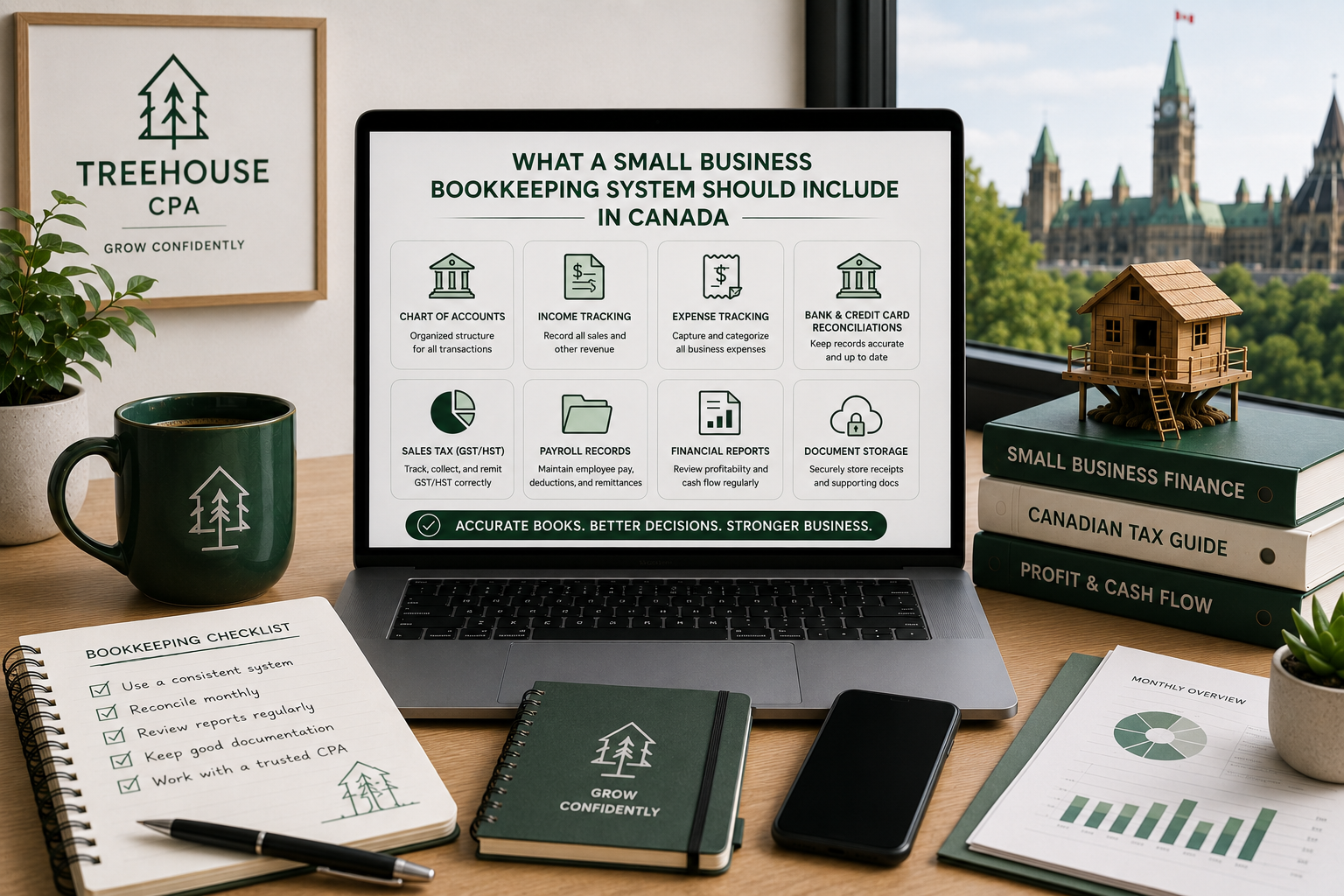
A small business bookkeeping system should usually include:
- a chart of accounts that matches how the business actually operates;
- separate business bank and credit card activity;
- income records tied to invoices, deposits, contracts, or platform reports;
- expense records supported by receipts, invoices, and business-purpose notes;
- GST/HST tracking if the business is registered or close to registration;
- payroll records if the business has employees;
- owner loan, draw, salary, dividend, or reimbursement tracking;
- bank and credit card reconciliations;
- month-end review steps;
- document storage that keeps records available for CRA review;
- a deadline calendar for GST/HST, payroll, income tax, corporate filings, and instalments where relevant.
The goal is simple: your books should support tax filings and business decisions without turning every year-end into a cleanup project.
1. A Clear Chart of Accounts
The chart of accounts is the list of categories used in your bookkeeping file.
It should be detailed enough to be useful, but not so detailed that every transaction becomes a debate. For many small businesses, the chart should separate sales or professional fees, direct costs, subcontractors, wages and benefits, rent, advertising, software, vehicle costs, meals and entertainment, office expenses, professional fees, shareholder or owner transactions, GST/HST collected and paid, loans, credit cards, and other liabilities.
For incorporated businesses, the categories should also support corporate tax preparation and financial statement reporting. Resident corporations generally file a T2 return every tax year, and corporate bookkeeping should usually produce balance sheet and income statement information that can be mapped to the General Index of Financial Information, or GIFI, where required. Sole proprietors do not file T2 returns, but they still need records that support business income and expense reporting.
This is where many small businesses get messy. Too few categories hide important details. Too many categories make reports hard to read and inconsistent from month to month.
2. Separate Business Banking
A reliable bookkeeping system starts with separation.
At a minimum, business income and expenses should run through business bank accounts and business credit cards where possible. This makes reconciliation cleaner and reduces the risk that personal spending gets mixed into business records.
For incorporated businesses, separation is especially important because the corporation is a separate legal taxpayer. If personal costs are paid by the corporation, they need to be reviewed carefully. Some may be shareholder loans, reimbursements, salary, dividends, taxable benefits, or personal expenses paid by the corporation, depending on the facts.
The bookkeeping system should not leave these items in vague categories such as "miscellaneous" or "owner expense." It should show what happened so the tax treatment can be reviewed.
3. Income Records That Match the Bank
Your bookkeeping system should show not only that money was deposited, but where it came from.
For example, income support might include customer invoices, point-of-sale reports, Stripe, Square, PayPal, or platform reports, contracts, deposit slips, bank statements, sales summaries, and refund or discount records.
The bank deposit is only one part of the story. A $5,000 deposit could be taxable sales, a shareholder contribution, a loan, a transfer between accounts, a refund, or something else. The bookkeeping system should make the nature of the deposit clear.
4. Expense Records With Receipts and Business Purpose
An expense category in software is not enough on its own.
Your system should connect each expense to the source document and, where needed, the business reason. That usually means invoices, receipts, contracts, emails, mileage logs, or other supporting documents.
Bank statements and credit card statements are helpful because they show payment. On their own, they do not always show what was purchased, who the supplier was, whether GST/HST was charged, or whether the expense was business-related.
For self-employed business owners, this is especially important because personal and business spending often happen close together. If you are gathering records for a self-employed return, Treehouse CPA's self-employed tax checklist for Canadians gives a useful overview of what to collect before filing.
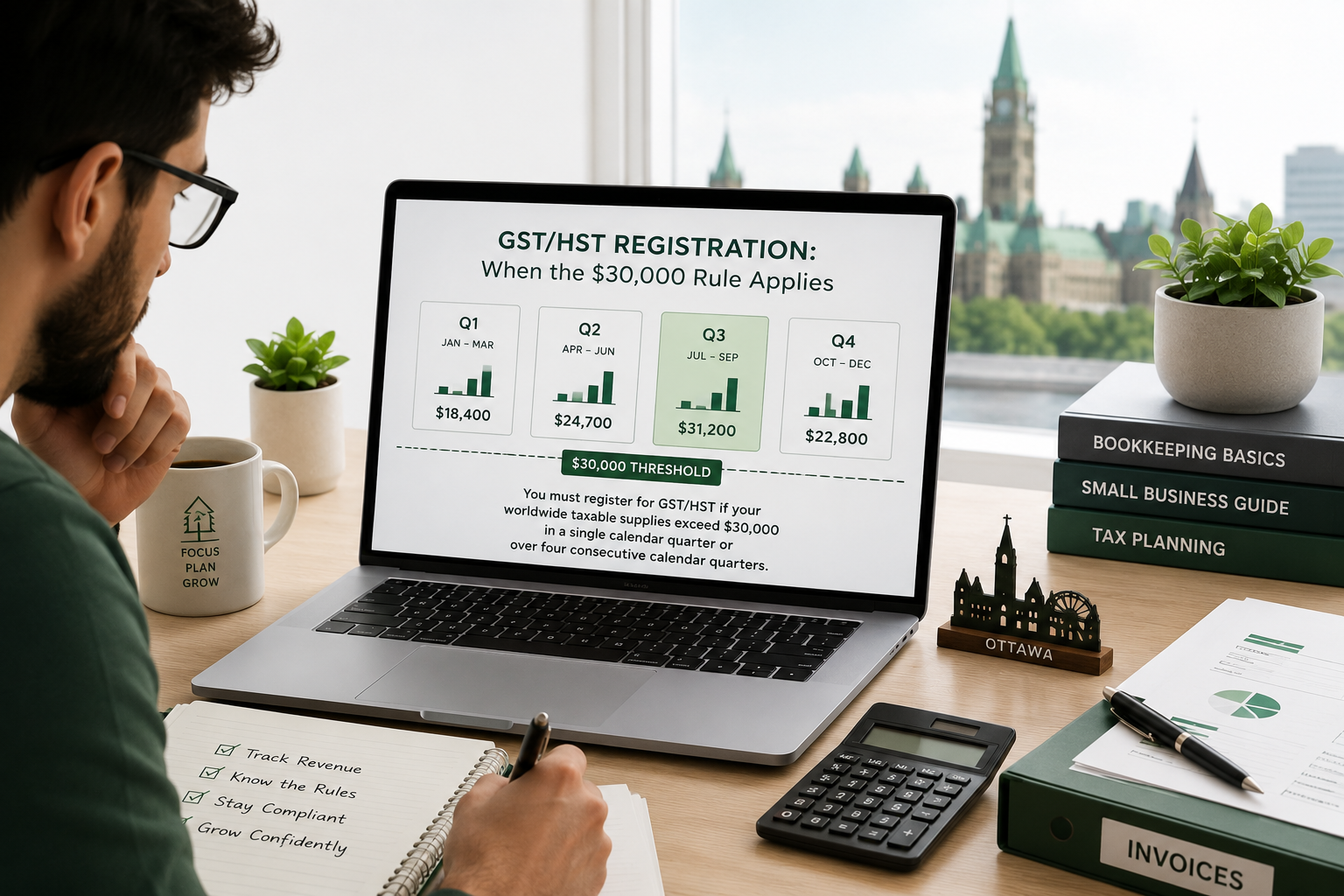
5. GST/HST Tracking
If the business is registered for GST/HST, the bookkeeping system needs to track tax collected on sales and tax paid on eligible business purchases.
For Ontario businesses, many taxable supplies are charged at 13% HST, but the correct rate depends on the place of supply and the type of supply. Some supplies are zero-rated or exempt, and cross-border or interprovincial sales may need a closer look.
The system should help answer whether GST/HST was charged where required, whether exempt or zero-rated sales were recorded correctly, whether invoices support input tax credits, whether GST/HST returns are filed on the correct frequency, and whether amounts collected are being set aside for remittance.
Do not rely only on a bank feed for GST/HST. Documentation is necessary for an input tax credit claim, but it is not enough by itself. The purchase must also satisfy the GST/HST ITC rules and relate to the business's commercial activity. Your system should keep the invoice details needed to support the claim, including supplier name, date, amount, GST/HST registration number, tax details, and purchase description when required.
For deadline planning, see Treehouse CPA's guide to CRA tax deadlines for small businesses.
6. Payroll Records and Remittance Calendar
If the business has employees, bookkeeping and payroll cannot be treated as separate worlds.
The system should keep payroll records such as employee names and basic payroll details, hours worked, gross pay, income tax withheld, CPP contributions, EI premiums, employer CPP and EI amounts, TD1 forms, T4 slips and summaries, payroll remittance confirmations, benefit and reimbursement records, and CRA letters of authority and registered pension information where applicable.
Payroll remittance deadlines depend on the payroll account's CRA-assigned remitter type and the relevant pay or remitting period. A regular monthly remitter generally remits by the 15th day of the next month, but quarterly and accelerated remitters have different due dates. Your bookkeeping system should track the actual payroll obligations for your business rather than assuming one universal deadline.
7. Owner Transactions and Reimbursements
Owner transactions are one of the most common problem areas in small business bookkeeping.
For sole proprietors, owner draws are usually not wages. For corporations, money moving between the owner and the corporation may be salary, dividends, reimbursements, shareholder loans, repayments, capital contributions, or personal expenses paid by the company.
Reimbursements should be supported by the original expense details and the business reason. If an owner paid a business expense personally and the corporation reimburses it later, the system should connect the reimbursement to the receipt, not simply record a lump-sum payment to the owner.
8. Reconciliations
A transaction feed is not the same as a reconciliation.
Each month, or at another cadence that fits the transaction volume and risk level, the bookkeeping system should reconcile bank accounts, credit cards, payment processor clearing accounts, loans, GST/HST payable, payroll liabilities, accounts receivable, and accounts payable.
Reconciliation is how you catch duplicate transactions, missing deposits, old outstanding cheques, incorrectly matched transfers, bank-feed outages, and payment processor fees.
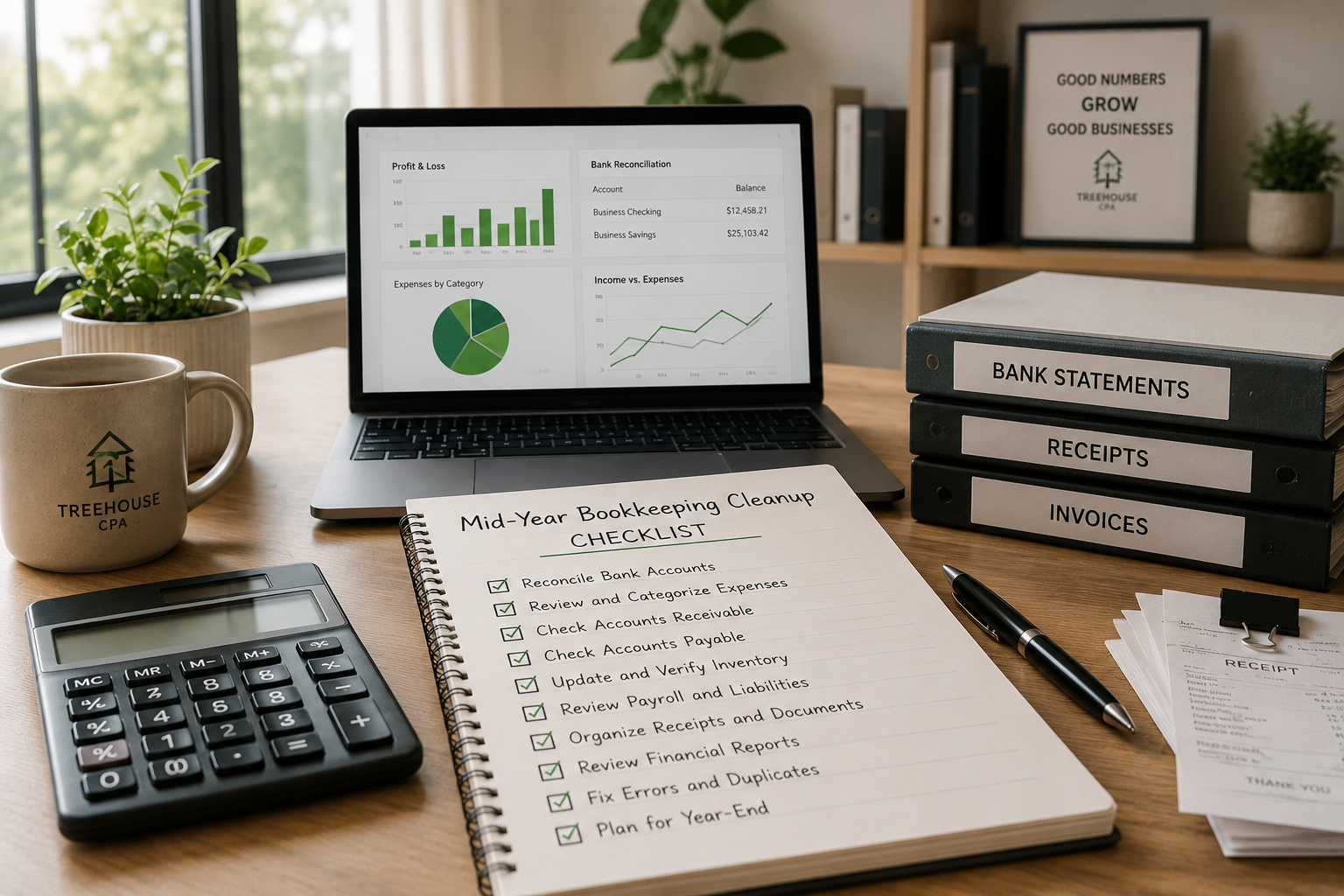
If the books have not been reviewed in a while, a cleanup may be needed before the system can be trusted. Treehouse CPA's mid-year bookkeeping cleanup checklist covers the kinds of issues that often show up.
9. A Month-End Review Process
A practical small business bookkeeping system should include a short month-end routine.
That routine might include reconciling bank and credit card accounts, reviewing uncategorized transactions, uploading missing receipts, checking accounts receivable and accounts payable, reviewing payroll liabilities, reviewing GST/HST payable, comparing profit and cash flow, noting unusual transactions for the CPA, and saving key reports.
This does not need to be complicated. The point is to stop problems from sitting untouched until tax season.
10. Document Storage and Record Retention
CRA recordkeeping rules are not only about accounting reports. They are also about keeping the supporting records.
Your records should be reliable, complete, supported by source documents, and kept in a form that can be made available to CRA if requested. CRA guidance also expects required records to be kept in English, French, or a combination of the two.
In general, business records should be kept for six years from the end of the last tax year they relate to. The six-year rule has exceptions. Keep records longer when they relate to a late-filed return, an objection or appeal, a CRA request to retain records, long-term property or corporate history, and certain dissolved-corporation situations.
Electronic records need to remain readable and accessible for the required retention period, even if paper or image copies exist. If you use a cloud bookkeeping app, receipt tool, point-of-sale system, payment processor, or payroll system, export or retain the records you need before changing or cancelling the service.
11. Useful Management Reports
The system should produce reports that a business owner can actually use.
At minimum, that usually means profit and loss statement, balance sheet, accounts receivable list, accounts payable list, GST/HST summary, payroll liability report, expense detail by category, and owner loan or draw detail.
These reports help with tax filings, but they also help you notice issues early. For example, if profit is fine but cash is tight, the answer may be receivables, debt payments, inventory, GST/HST collected but not set aside, or owner withdrawals.
What Your System Does Not Need
Your system does not need to be overly complicated.
A small consulting business does not need the same workflow as a construction company with subcontractors, job costing, holdbacks, vehicles, and payroll. A sole proprietor with a few monthly invoices may not need the same reporting structure as an incorporated business with employees and GST/HST filings.
The right system should be strong enough to support tax filings and decisions, but simple enough that it actually gets used.
What Happens When You Bring This to Majdi Ibrahim, CPA?
When Treehouse CPA reviews a bookkeeping system, the goal is not to make the file look fancy. The goal is to make it usable.
That often means reviewing the chart of accounts, bank and credit card setup, GST/HST coding, payroll liabilities, owner transactions, source-document habits, month-end close process, and year-end reporting needs.
The review can be scoped to setup, cleanup, or ongoing support, depending on what the business actually needs.
If you are comparing bookkeeping support options, Treehouse CPA's article on how much bookkeeping costs for a small business in Canada explains why the price depends on transaction volume, cleanup needs, payroll, GST/HST, and review complexity.
If you are preparing for a first review, the guide on what to bring to your first accountant meeting is a useful starting point.
Common Mistakes
Common bookkeeping system mistakes include using one category for too many expenses, relying on bank feeds without receipts, leaving owner transactions unresolved, not reconciling payment processors, recording GST/HST based only on guesses, ignoring payroll liabilities until remittance time, mixing business and personal expenses, waiting until year-end to clean up the file, and assuming accounting software automatically makes records CRA-ready.
Ottawa and Ontario Context
Ottawa-area businesses often deal with a mix of local services, federal government contracting, Quebec customers, remote clients, and Ontario HST. A bookkeeping system should be built around the actual business model, not a generic template.
For example, a consultant in Kanata, a trades business in Barrhaven, a clinic in Orleans, and an online service provider with customers outside Ontario may all need different GST/HST coding, payroll workflows, and reporting categories.
Final Thought
The best bookkeeping system is the one you can keep current, support with documents, and use to make decisions.
It should not depend on memory. It should not leave major tax questions until the filing deadline. And it should not require a full cleanup every time you need reliable numbers.
If your books are hard to explain, hard to reconcile, or hard to use for tax filings, it may be time to rebuild the system before another year passes.
Book a consultation at www.treehousecpa.com
FAQ
Is accounting software enough for a bookkeeping system?
No. Accounting software is only one part of the system. You also need a clear process for receipts, reconciliations, GST/HST, payroll, owner transactions, document storage, and review.
How long should small business records be kept in Canada?
In general, business records should be kept for six years from the end of the last tax year they relate to. Some situations require a different or longer period, including late-filed returns, objections, appeals, certain property or corporate history records, CRA retention requests, and dissolved-corporation situations.
Do bank statements replace receipts?
Usually no. Bank statements help show payment, but they often do not show the full details needed to support the business purpose, GST/HST treatment, supplier information, or exact item purchased.
What should a bookkeeping system include for GST/HST?
It should track sales tax collected, GST/HST paid on purchases, input tax credit support, filing frequency, remittance deadlines, and sales that may be taxable, zero-rated, exempt, or outside the normal Ontario pattern.
When should a small business review its bookkeeping system?
At minimum, review it before year-end and any time the business adds employees, registers for GST/HST, incorporates, changes software, falls behind, or starts making decisions based on reports.
Disclaimer
This article is general information for Canadian small business owners and does not provide legal, tax, or accounting advice for your specific situation. Rules can change, and the right treatment depends on your facts. Speak with a qualified CPA before acting on tax-sensitive matters.