What to Do If Your Corporation Has Unfiled T2 Returns in Canada

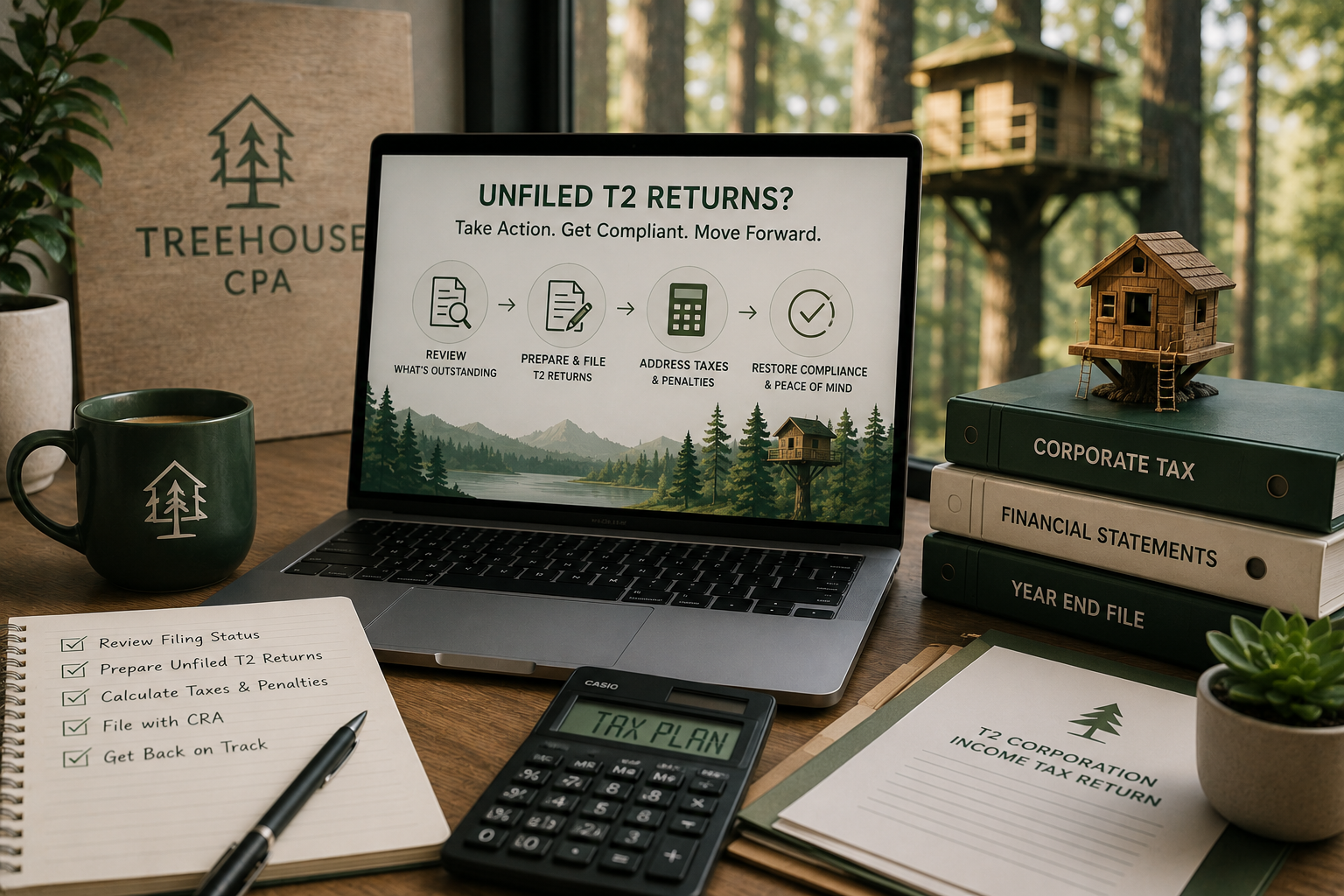
Behind on corporate tax filings? Learn what to do if your Canadian corporation has unfiled T2 returns, including CRA deadlines, penalties, payment planning, and cleanup steps
By Majdi Ibrahim, CPA | Majdi Ibrahim, CPA Professional Corporation | Ottawa, Ontario
If your corporation has missed one or more T2 corporate tax returns, the worst move is usually to ignore it and hope CRA does not notice.
The second worst move is to rush a filing without checking the records, the shareholder loan account, GST/HST, payroll, and payment position first.
A late corporate tax return is a fixable problem, but it needs to be handled in the right order. For an incorporated business owner in Ottawa, Kanata, Barrhaven, Orleans, Gatineau, or elsewhere in Canada, the practical question is not just "How fast can I file?" It is "What years are missing, what does CRA already know, what records are reliable, and what cash or payment plan is needed once the returns are assessed?"
This article explains what to do if your Canadian corporation has unfiled T2 returns, what CRA penalties and interest can look like, and how to catch up with fewer surprises.
At a Glance
Most resident corporations must file a T2 every year, even if there is no tax payable. CRA specifically includes inactive corporations in the filing obligation. The T2 filing deadline is not the same as the payment deadline. The return is generally due six months after the corporation's year-end, while the balance is generally due two or three months after year-end depending on the corporation. Late filing can trigger penalties and interest. CRA's standard late-filing penalty is based on unpaid tax, and larger penalties can apply in repeat or demand-to-file situations. Do not file blind. Before filing, reconcile bookkeeping, bank activity, GST/HST, payroll, owner withdrawals, and shareholder loan balances. A payment arrangement may be possible, but future compliance matters. CRA expects future returns and payments to stay current.
First: Confirm Which T2 Returns Are Missing
Start by identifying every corporate tax year that has not been filed.
For a corporation, the tax year usually follows its fiscal period, not necessarily the calendar year. A corporation with a March 31 year-end has different filing and payment dates than a corporation with a December 31 year-end.
CRA says a corporation income tax return is due within six months after the end of each tax year. If the tax year ends on the last day of a month, the filing deadline is the last day of the sixth month after year-end. For example, a March 31 year-end has a September 30 T2 filing deadline.
That is why the first cleanup step is a simple list:
- corporation legal name
- business number and RC account
- fiscal year-end
- last T2 return filed
- missing tax years
- whether CRA has sent a request or demand to file
- whether there are missing GST/HST, payroll, or information returns too
If you are behind on several filings, it may help to read Treehouse CPA's broader guide to catching up on overdue taxes, then come back to the corporation-specific steps here.
Even Inactive Corporations Usually Still Have to File
Some business owners assume that if the corporation stopped operating, earned no income, or never really got started, there is no T2 filing requirement.
That assumption can create problems.
CRA states that resident corporations generally have to file a T2 every tax year even if no tax is payable, and CRA's page includes inactive corporations in that requirement. There are exceptions for certain entities, but an ordinary private corporation usually should not assume it is exempt just because activity was low or nil.
If your corporation is inactive, the return may be simpler, but it still needs to be handled properly. You may also need to review whether GST/HST or payroll accounts should be closed and whether the corporation should be legally dissolved. Closing accounts and dissolving a corporation are separate steps from filing the missing T2 returns.
Understand the Difference Between Filing Late and Paying Late
Corporate tax timing has two separate pieces:
- The filing deadline: generally six months after the corporation's tax year-end.
- The balance-due day: generally two months after year-end, or three months for some eligible CCPCs that meet CRA's conditions.
This difference surprises many owner-managers. A corporation might file its T2 by the six-month deadline and still owe arrears interest because the balance was due earlier.
For a broader deadline overview, see 5 CRA Tax Deadlines for Small Businesses.
If your corporation has several unfiled years, late-filing penalties and arrears interest can become material. CRA says the standard failure-to-file penalty is 5% of the unpaid tax due on the filing deadline, plus 1% of that unpaid tax for each complete month the return is late, up to 12 months.
CRA also describes a larger repeat penalty where CRA issued a demand to file and the corporation had a failure-to-file penalty assessed in any of the three previous tax years. In that situation, the penalty can be 10% of the unpaid tax when the return was due, plus 2% per complete late month, up to 20 months.
Interest is separate. CRA charges arrears interest, compounded daily, on unpaid balances from the balance-due day to the date of payment.
Gather the Records Before You File
The goal is not only to submit a T2. The goal is to submit a return that is supportable.
For each missing year, gather:
- bank and credit card statements
- bookkeeping file or accounting ledger
- sales invoices and deposit support
- expense receipts and supplier statements
- loan agreements and financing statements
- payroll records, if the corporation had employees
- GST/HST returns and working papers, if registered
- shareholder loan details
- dividends, salary, and owner withdrawal records
- asset purchases, leases, and vehicle records
- prior-year financial statements and T2 returns
- CRA notices, account statements, and correspondence
If the bookkeeping is incomplete, start with the bank accounts and rebuild the year carefully. A rushed return based on partial information can create a second problem after the first one is solved.
For cleanup before year-end or before filing, the principles in the corporate year-end tax planning checklist are useful, even if the corporation is already behind.
Pay Special Attention to Owner Withdrawals
When a corporation is behind on T2 filings, owner withdrawals are often one of the messiest areas.
Money may have moved from the corporation to the owner during the unfiled years. That movement might be salary, dividends, reimbursement of expenses, repayment of a shareholder loan, a new shareholder loan, or something else. These are not interchangeable.
This matters because the T2 return, financial statements, T4 slips, T5 slips, payroll remittances, and shareholder loan account should tell the same story.
If you paid yourself from the corporation but the records are unclear, review the issue before filing. Treehouse CPA has separate guides on how to pay yourself from a corporation and shareholder loan rules. Those issues often show up during a T2 catch-up project.
File the Returns in the Right Order
When several years are missing, the returns usually need to be prepared in sequence.
That is because one year's closing balances become the next year's opening balances. Retained earnings, shareholder loan balances, capital assets, loss carryforwards, taxes payable, and GST/HST balances may all roll forward.
For example, if 2022, 2023, and 2024 are unfiled, it is usually risky to prepare 2024 first without rebuilding 2022 and 2023. The numbers may not connect.
The work often looks like this:
- Confirm the last filed return and accepted opening balances.
- Rebuild or clean up bookkeeping for the earliest missing year.
- Prepare financial statements and the T2 for that year.
- Carry closing balances forward.
- Repeat for each missing year.
- Compare estimated tax, penalties, and interest against available cash.
- File electronically where required.
- Monitor CRA assessments and account balances.
For tax years starting after 2023, CRA says most corporations have to file T2 returns electronically, subject to listed exceptions. CRA also says a $1,000 penalty can apply for non-compliance where a corporation is required to file electronically and does not comply.
What If You Cannot Pay the Balance Right Away?
File the returns and payment planning should be coordinated, but not confused.
If a corporation owes tax and cannot pay immediately, CRA says corporate income tax debt can be scheduled through My Business Account for eligible payment arrangements. CRA also says taxpayers may call to set up a payment arrangement, and that if a collections officer has written to you, you should call them at the number provided.
A payment arrangement does not erase the debt. Interest can continue, and CRA expects the corporation to keep future filings and payments current.
This is why a catch-up plan should include a cash-flow review. For an incorporated consultant in Kanata or contractor in Barrhaven, the question might be:
- What is the estimated tax balance for each missing year?
- Are GST/HST or payroll balances also outstanding?
- Is the corporation still operating?
- Can the corporation make a lump-sum payment?
- If not, what monthly payment is realistic?
- Are future instalments or source deductions also due?
It is better to know this before CRA assessments arrive.
Should You Consider the Voluntary Disclosures Program?
Sometimes. Not always.
CRA's Voluntary Disclosures Program exists for taxpayers who want to correct certain past filing or reporting issues. CRA changed the program effective October 1, 2025. Current CRA guidance lists an unfiled return that is at least one year late as an example of a situation that may be eligible, but an application must satisfy all of CRA's conditions.
Those conditions include applying before an audit or investigation has started against you or a related taxpayer about the information being disclosed, providing all relevant information and documents, having an error or omission that attracts interest or penalties, being at least one year or one reporting period late, and including estimated tax payment or requesting a payment arrangement that remains subject to CRA approval.
VDP is therefore not a simple late-filing discount. A CRA letter or demand does not answer the eligibility question by itself; the nature and stage of CRA's compliance action matter. If VDP might be relevant, review the current criteria before filing the missing returns.
For a plain-English overview, read Canada's Voluntary Disclosure Program Explained by an Ottawa CPA, then get advice before assuming it applies.
What About Taxpayer Relief?
CRA can sometimes cancel or waive penalties and interest under taxpayer relief provisions where the taxpayer could not meet obligations because of circumstances beyond their control. CRA's interest page says its discretion is limited to periods within the 10-calendar-year window described on that page.
This should be positioned carefully. Taxpayer relief is not automatic. A request needs facts and support. It may be relevant where illness, serious disruption, CRA error, or other qualifying circumstances contributed to the late filing or late payment.
CRA distinguishes between waiving penalties or interest before they are assessed and cancelling amounts after they are assessed. A request can therefore arise before or after assessment, depending on the facts. The request is still subject to CRA's discretion, supporting evidence, and the applicable 10-year limits.
In many catch-up files, a practical sequence is:
- Get the filings accurate and current.
- Understand the assessed penalties and interest.
- Check the relief deadline and decide whether to request waiver or cancellation.
- Submit a focused request with documents if appropriate.
Do Not Ignore GST/HST, Payroll, or Information Returns
Unfiled T2 returns often point to a wider compliance issue.
If the corporation was registered for GST/HST, the GST/HST returns should be reviewed. If it had employees, payroll remittances and T4 slips need attention. If it paid subcontractors in construction, T5018 reporting may be relevant. If it had non-arm's length foreign transactions, foreign reporting may be relevant.
Do not assume the T2 is the only missing item. CRA accounts connect to each other, and a clean catch-up plan should check all active program accounts.
A Practical Example
Assume an Ottawa incorporated IT consultant has a December 31 year-end. The 2023 and 2024 T2 returns were never filed. The corporation continued operating, paid the owner irregular amounts, collected HST, and made some estimated corporate tax instalments but not consistently.
The owner wants to file "just to get it done."
A better approach is to:
- pull CRA account balances and correspondence
- confirm which returns and instalments CRA shows as missing
- reconcile bank and credit card accounts for 2023 first
- classify owner withdrawals as salary, dividends, shareholder loan activity, or reimbursements where supportable
- reconcile HST collected and input tax credits
- prepare the 2023 financial statements and T2
- carry the balances forward into 2024
- prepare the 2024 T2
- estimate arrears interest, late-filing penalties, and any payment arrangement need
- file and monitor assessments
This takes more care than a rushed filing, but it gives the owner a much clearer picture of the real liability.
Common Mistakes
Assuming inactive means no filing. CRA generally still expects resident corporations to file T2 returns even if no tax is payable.
Filing the newest year first. If older years are missing, the newest year may rely on opening balances that have not been rebuilt.
Ignoring the shareholder loan account. Owner withdrawals can create technical issues if they are not reviewed.
Forgetting the payment deadline. The T2 filing deadline is generally six months after year-end, but the balance may have been due earlier.
Treating VDP as automatic. VDP needs a facts-based review.
Not checking GST/HST and payroll. Corporate cleanup often involves more than the T2 return.
Waiting for CRA collections. It is usually better to come forward with a plan than to wait until the file escalates.
Ottawa and Ontario Relevance
Many local corporations fall behind during transitions: a consultant leaves employment and incorporates, a trades business grows quickly, a medical professional starts a professional corporation, or a small business changes bookkeepers and loses momentum.
This is common across Ottawa, Kanata, Barrhaven, Orleans, and the surrounding area. The important point is to treat it as a compliance project, not a source of shame and not a do-it-later item.
If CRA has already sent letters, bring them to the review. If no letters have arrived yet, that does not mean the issue is safe to leave alone.
What Happens When You Bring This to Majdi Ibrahim, CPA?
We start with the missing years. We confirm the corporation's year-end, last filed return, CRA account status, and which years need to be prepared.
We review the records before filing. Bank activity, bookkeeping, GST/HST, payroll, owner withdrawals, and shareholder loans need to make sense before the T2 is submitted.
We estimate the tax and cash impact. The goal is to avoid surprises when CRA assesses the returns.
We coordinate the cleanup order. If several years are missing, we work through them in sequence so the numbers roll forward properly.
We flag relief or VDP questions. If the facts suggest taxpayer relief or voluntary disclosure should be reviewed, we identify that before the corporation takes the next step.
Book a consultation at www.treehousecpa.com
Frequently Asked Questions
Does an inactive corporation have to file a T2 return in Canada?
Usually, yes. CRA says resident corporations generally have to file a T2 return every tax year even if there is no tax payable, and CRA includes inactive corporations in that filing requirement. Specific exceptions should be reviewed before assuming no return is needed.
How late can a corporation file a T2 return?
A late T2 can still be filed, but penalties and interest may apply. CRA also says a corporation must file no later than three years after the end of a tax year to receive a tax refund for that year.
What is the penalty for filing a T2 late?
CRA's standard failure-to-file penalty is 5% of unpaid tax due on the filing deadline plus 1% of that unpaid tax for each complete month the return is late, up to 12 months. A larger repeat penalty can apply in certain demand-to-file situations.
Can CRA waive penalties and interest?
Sometimes, but it is not automatic. CRA has taxpayer relief provisions for certain situations beyond the taxpayer's control, subject to time limits and supporting facts.
Should I file my unfiled T2 returns before applying for VDP?
Do not assume the answer. Under CRA's current VDP rules, an application must be made before an audit or investigation has started about the information being disclosed and must meet four other conditions. Review the current criteria before filing if VDP may be relevant.
Can I close or dissolve the corporation instead of filing old T2 returns?
Dissolution and CRA filing obligations are separate issues. If the corporation still exists, CRA generally expects the required returns to be filed, even if the business is inactive.
Disclaimer
This article is general information only and is not legal, tax, or accounting advice for your specific situation. Tax rules change, and the right answer depends on your facts. Speak with a qualified CPA before relying on this information for a decision.